
Custom 925 Silver Jewelry: Rhodium and Gold Plating
Rhodium keeps silver looking like silver; gold plating turns it into a different product line. The published menu is multi-layer precious-metal electroplating in 14K, 18K or 24K gold or rhodium, with an anti-tarnish e-coating added on silver and brass orders. That is a four-way colour choice on a material whose MOQ is 50 pcs per design — and one of six customisation categories a buyer controls.

Key takeaways
- Plating options are 14K, 18K, 24K gold or rhodium, applied in multiple layers over the base metal.
- Silver and brass orders receive a protective anti-tarnish e-coating; stainless steel is finished with PVD vacuum plating instead.
- MOQ for 925 sterling silver is 50 pcs per design, so a plating colour can be tested on a real run rather than a lab sample.
- Packaging is a separate published option with five named components, from logo tags to barcode labels.
Rhodium and gold do different jobs on silver
Silver is a white metal that tarnishes. Rhodium plating solves both halves of that problem at once: it is white, so the piece keeps reading as silver, and it is a harder metal than the silver beneath it, so the surface resists the small abrasions that start a tarnish patch. It is the default choice for a design that must look like plain sterling.
Gold plating changes the product, not just the surface. A 14K deposit gives a warm, shallow tone; 18K sits in the middle; 24K is the deepest yellow and reads as a statement piece. Because the deposit is built in multiple layers, the colour is a schedule decision rather than a single dip, and it belongs on the CAD sheet along with everything else.
Silver and stainless steel are finished differently
Electroplating works on silver and brass because both metals take a deposit readily. Stainless steel does not go through the same tank; it is finished with PVD vacuum plating, which the client lists as its own route. If your range mixes materials, the finish schedule is two schedules, and pretending otherwise is how a range ends up with two slightly different golds.
The protective layer differs for the same reason. Silver and brass get anti-tarnish e-coating on top of the plating. Stainless steel gets its durability from the PVD layer itself. The positioning phrase used for the steel line is waterproof plating, which is a statement about surviving daily wear, not a depth rating.
For silver specifically, four published details frame the plating decision: every piece is stamped S925, the metal is described as nickel-free and allergy-free, the plating is eco-friendly electroplating on a 925 base, and the quality block lists A BSCI audit, ISO 9001:2015 certification and REACH compliance on lead, cadmium and nickel. Sample testing ahead of production is listed alongside them, so the coating and the colour are checked on a piece rather than promised in a brochure.
What the e-coating does to a reorder
An e-coating is a clear barrier over the plated surface. It changes what the piece does in storage, and it changes nothing about what the piece is: the hallmark stays S925, the alloy stays 92.5% silver. When you reorder, the coating should be named in the same field of the spec sheet as the plating colour, so the second batch ships with the same top layer as the first.
If a batch arrives without it, the symptom is not obvious in a photograph. It shows up three months later in a shop window, which is why the coating line belongs in the order confirmation and not just in a marketing sentence.
Plating colour as a range-planning tool
Four colour options across one design lets a brand build a coherent range without new tooling: one mould, one CAD file, and a colour split across the order. Silver with rhodium, silver with 18K gold, brass with 24K gold and stainless with PVD covers four retail price points from a single design library.
Because 925 sterling silver starts at 50 pcs per design, the colour split can be uneven. A 200-piece opening order on one design can run 120 pieces in rhodium and 80 in 18K gold without touching the minimum, as long as every variant stays at or above 50.
Packaging, because plating is only half of the unboxing
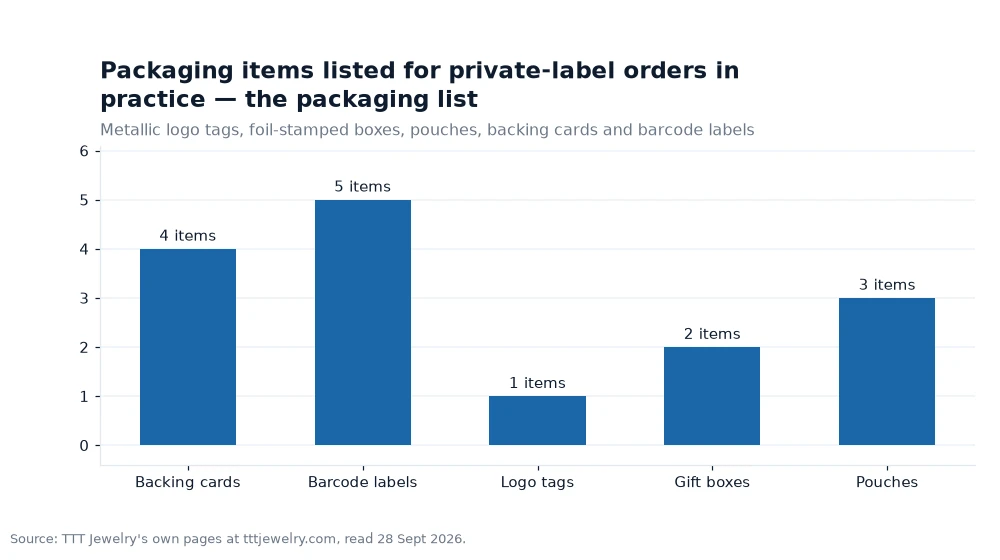
The packaging list published for custom orders has five named parts: labelling with barcodes, velvet or microfiber pouches, metal logo tags, foil-stamped gift boxes and display cards with backing. Each one does a job. The pouch protects a plated surface from abrasion in transit; the backing card makes a piece giftable; the barcode makes it sellable in a stock system.
A custom 925 silver jewelry manufacturer prices plating and packaging off the same document, so a single sheet is also a single quote. Pair the packaging with the plating decision and the whole order can be spec'd on one page: pouch for protection, box for the gift, tag for the brand, card for retail, barcode for the stockroom. Engraving, hallmarks and packaging all belong in the same document as the plating schedule.
| Item | Published detail | What it protects or proves |
|---|---|---|
| Logo tags | Metallic, custom | Brand mark on the finished piece |
| Gift boxes | Foil-stamped | Retail presentation and gifting |
| Pouches | Velvet or microfiber | Abrasion protection for a plated surface |
| Backing cards | Display format | Makes the piece sellable off a hook |
| Barcode labels | Custom labelling | Stock control and marketplace listing |
Worked example: one design, four finishes, one minimum
Take one silver design with a published minimum of 50 pcs per design. Running it in three colours means the order is split three ways, and every split has to stay at 50 or more. Three colours × 50 = 150 pieces is the smallest order that carries three finishes; four colours × 50 = 200 pieces carries all four.
Now add packaging. If the plan is a pouch and a backing card for every piece, the packaging quantity equals the piece count: 150 pouches and 150 cards for the three-colour run. Plating colour and packaging lane are both specified per order, so the arithmetic is simple multiplication rather than a new quote. The 50-piece minimum is the published figure; the split is my own planning example.
Testing a plating colour without a production run
The master sample stage exists for exactly this: 25–30 days covering wax printing, casting, stone setting, polishing and electroplating. A sample ordered in the intended plating colour is a real answer, and a sample ordered in a different colour is a wasted cycle. Specify the finish in the sampling brief, not after it.
What a sample cannot tell you is how the colour holds after six months of wear, because nothing in a 25–30 day window simulates that. The protection question — e-coating on silver, PVD on steel — is the part you have to take on documentation rather than on demonstration.
Frequently asked questions
Can one silver design be ordered in several plating colours?
Yes. Plating and finishes are one of the published customisation options, and each colour variant has to meet the 50 pcs per design minimum in 925 sterling silver.
Does gold plating on silver change the hallmark?
The hallmark declares the base metal, so a plated silver piece still carries S925 rather than an 18KGP mark, which is reserved for gold-plated articles.
How is stainless steel different from silver when plating?
Stainless steel is finished with PVD vacuum plating rather than precious-metal electroplating, and it does not receive the anti-tarnish e-coating used on silver and brass orders.
Specifying the finish on one sheet
Plating colour, protective layer, hallmark, engraving and packaging amount to five lines on a single specification document. A workshop that works from that sheet will quote the pieces it can actually make; one that works from a verbal brief will quote something else entirely.
For ranges that mix metals, it is worth reading how the steel line handles finishing before deciding which pieces cross the materials boundary, and keeping the plating schedule for each material in its own column. The common questions page covers the engraving and hallmark points that come up most often on a first silver order.
Everything factual here — the per-piece inspection rule as well as the 3–4 week production window plus the S925 purity stamp — comes from the supplier's own site on tttjewelry.com's own pages, checked 28 Sept 2026. No figure above is estimated. The restatement in weeks is my own, and nothing else here[1].