
Mining Calculator Math: Turning Hashrate Into Daily Bitcoin
A mining calculator is division with a price tag attached, not a forecast. Enter 424 TH/s against the 21 September 2026 network reading and it returns 0.00019021 BTC a day, or $16.11 at $84,692 per coin. Every other figure on the screen — net income, weekly totals, payback — is built from that one line.

Key takeaways
- At 1,003 EH/s and a 3.125 BTC subsidy, one terahash earns 0.0000004486 BTC a day before fees.
- 424 TH/s produces 0.00019021 BTC, or $16.11 gross and $15.46 net at the listed 4%.
- Scaling is linear: 1.696 PH/s is four times 424 TH/s, and 4.24 PH/s is ten times.
- Output shifts with difficulty and price, so any single day of estimate is a snapshot.
What the screen is dividing
Four inputs drive the answer. Your hashrate is the only one you control. The network total, 1,003 EH/s in the reading used here, sets your share of it. The subsidy and block count fix the daily supply at 450 BTC, because 3.125 coins times 144 blocks comes to 450. The coin price turns that supply into dollars. A calculator takes your slice of the network, multiplies by the daily supply and the price, then applies whichever fee you selected.
The hashrate field deserves more suspicion than the other three, because it is the one people guess. A spec sheet number is measured at a fixed frequency and a friendly ambient temperature. What the pool actually sees is a share rate after firmware overhead, rejected submissions, restarts and thermal throttling. A machine rated at 424 TH/s might report 415 TH/s on a hot afternoon and 426 TH/s on a cold night. Use the daily average from your pool dashboard, not the figure printed on the carton.
The price field is easier, but only if you decide what it represents. Spot price at the moment you run the tool, a round number you expect to hold for a quarter, or yesterday's close — each produces a different answer, and none is wrong as long as you remember which one you used. Mixing a spot price with a difficulty estimate from a different date is how two people with the same hardware end up arguing about numbers that were never comparable.
Gross, net, and where the fee lands
PPS+ is the default payout scheme, and its listed rates sit on two separate components rather than on one total. The block-reward portion settles as PPS and carries 4%. The transaction-fee portion is distributed on PPLNS logic and carries 2%. Under plain PPLNS the two components are combined and the listed rate is 2% on that combined figure. Reading 4% and 2% as a 6% charge on everything is the most common error in this arithmetic, and it overstates the cost of mining.
The net column here applies the listed 4% to the block-reward share, which is where nearly all income comes from at current fee levels. So $16.11 gross becomes $15.46 net, and the visible change is close to 4%. On a day when blocks carry unusually heavy fees, the 2% rate on the fee component pulls the blended charge slightly lower. The full fee schedule lists the components separately, and it is worth reading once before trusting a third-party tool that applies a single percentage to the whole payout.
Payout timing matters for cash flow rather than for the total. PPS+ credits hourly against current difficulty, so a day of mining appears as twenty-four small entries. PPLNS pays after six confirmations, sharing your slice of the last five difficulty rounds, which can mean a day of silence followed by a larger credit. Neither schedule changes the annual arithmetic much; they change how the month feels.
Three hashrates, one rate per terahash
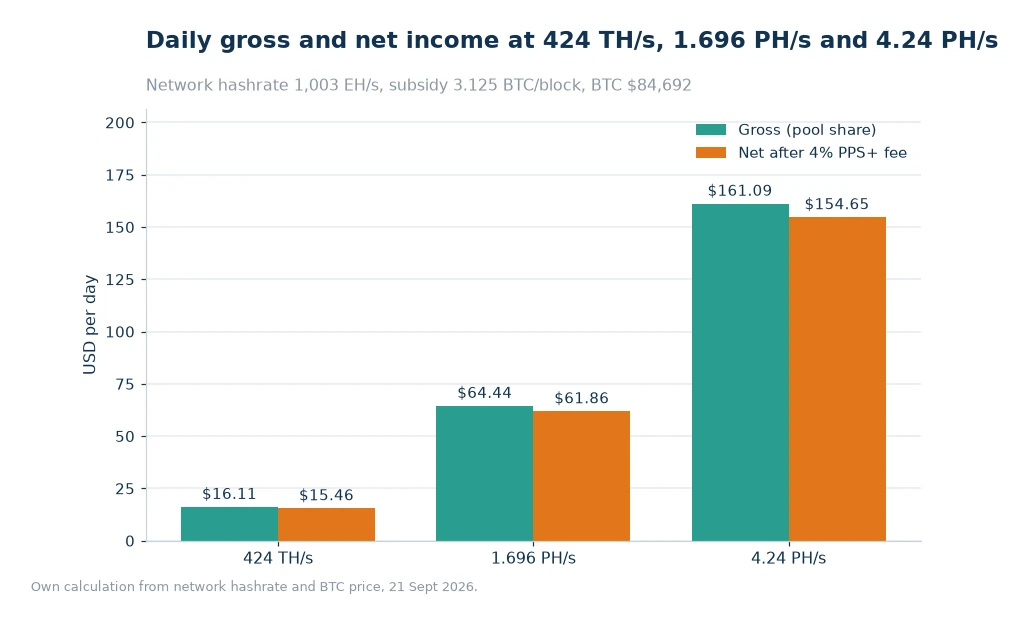
The three columns below are a single modern air-cooled machine at 424 TH/s, a four-machine rack at 1.696 PH/s, and a container-sized 4.24 PH/s. Placing them side by side shows that the pool pays no bonus for size. The rate per terahash is identical; only the multiple changes. That flatness is useful, because you can value one terahash once and scale it instead of building a fresh model for every purchase.
| Hashrate | BTC per day | Gross USD | Net USD |
|---|---|---|---|
| 424 TH/s | 0.00019021 | $16.11 | $15.46 |
| 1.696 PH/s | 0.00076092 | $64.44 | $61.86 |
| 4.24 PH/s | 0.00190209 | $161.09 | $154.65 |
The middle row is four times the first and the last is ten times the first. Use that as a sanity check on any tool: if the returned figures are not proportional, an input changed between runs. The most common culprit is the fee selector, which some calculators reset to a default when you change the hashrate.
Worked example
Follow the arithmetic from the network total down to a wallet entry.
- The network mints 450 BTC a day: 3.125 BTC per block, 144 blocks.
- Per TH per day: 450 ÷ 1,003,000,000 = 0.0000004486 BTC.
- 424 TH/s: 424 × 0.0000004486 = 0.00019021 BTC.
- In dollars: 0.00019021 × 84,692 = $16.11.
- After the listed 4% on the block-reward component: 16.11 × 0.96 = $15.46.
- 1.696 PH/s is 1,696 TH/s: 1,696 × 0.0000004486 = 0.00076092 BTC, or $64.44 gross and $61.86 net.
- 4.24 PH/s is 4,240 TH/s: 4,240 × 0.0000004486 = 0.00190209 BTC, or $161.09 gross and $154.65 net.
- One week at 424 TH/s: 7 × 15.46 = $108.22 net, the figure to hold against seven days of power.
Where the estimate drifts
Two variables do most of the moving. The next difficulty estimate in this reading was −2.12%, which lifts output per terahash a little; a rise of the same size does the opposite. Price is louder. A 10% move in BTC revalues the same coins by 10% without touching a single share, which is why an estimate built on one day's price can look badly wrong a month later.
Uptime is the third variable, and the one a calculator usually ignores. A rig that runs 23 hours a day rather than 24 loses roughly 4% of its income, more than the difference between the two payout schemes. Rejected shares, pool luck and firmware crashes land in the same bucket. Model them as a reduction on the gross figure before comparing the result with a power bill, or the comparison will flatter the hardware.
Power is the input the calculator lacks
Take a 424 TH/s machine drawing 20 J/TH as an assumption. That is 8.48 kW, or 203.5 kWh a day. At $0.06 per kWh the power bill is $12.21, which leaves $3.25 a day from the $15.46 net figure before any hardware cost. Change the tariff to $0.10 and the same machine nets $15.46 − $20.35, a loss. Nothing about the pool changed; the site did.
This is why the calculator's output should be read as revenue, not profit. It answers a narrow question well: how many coins does this hashrate produce at these network conditions? Whether those coins cover the electricity is a second calculation with inputs the tool never asks for — tariff, cooling load, ambient temperature, and the capital already sunk into the machine.
Using the tool without fooling yourself
Run the same hashrate twice, with two prices and two difficulty levels, instead of once. The spread between the runs tells you how much of your plan rests on conditions you cannot control. The ViaBTC Mining Calculator keeps price, difficulty, fee and effective hashrate as separate fields, which makes those runs quick, and the Profit Calculator on the same site includes merged-mining output for coins that support it.
Save the output. Note the date, the inputs and the predicted daily BTC, then compare it with what the pool credits after a week. A gap of a few percent is normal and usually traceable to uptime. A gap of 20% means one input was wrong, and finding out which one teaches you more than another hour of modeling would.
Finally, resist the urge to annualize a single good day. Multiplying a peak by 365 assumes difficulty, price and uptime all hold for a year, and the difficulty estimate alone shows how quickly that assumption slips. A rolling thirty-day average of credits is a duller number and a far better base for a decision.
Frequently asked questions
How much does 424 TH/s earn in a day?
At a network hashrate of 1,003 EH/s and BTC at $84,692, 424 TH/s earns 0.00019021 BTC a day, which is $16.11 gross and $15.46 after the listed 4% on the block-reward component.
Does a mining calculator include electricity?
No. It models pool income from hashrate, network total, subsidy and price. Power, cooling and hardware are costs you subtract afterwards, and at 424 TH/s a net income of $15.46 a day leaves little room for a high tariff.
Why do two calculators disagree about the same rig?
Usually because one uses nameplate hashrate and the other a pool-reported average, or because they were run on different days with different difficulty and price inputs. Compare the input fields before comparing the results.
Start with your own numbers, not ours
Copy the average hashrate from your dashboard, the current difficulty, and the price you actually expect to sell at. Run the arithmetic once by hand so you know which field moves the answer, then let the tool handle the repetitions. The constants in this article will age; the live figures on the statistics page replace them without changing the method.
Sources: ViaBTC's pricing and calculator pages, for the listed 4% and 2% rates and the input fields[1]. Market inputs were read on 21 Sept 2026: BTC $84,692, network 1,003 EH/s, difficulty 132.76 T, 3.125 BTC every block across 144 daily blocks. Power figures assume 20 J/TH at the stated tariff and no downtime. Published 22 Oct 2026.